The science behind
Maneup Labs.
Hair loss isn’t one problem — it’s four overlapping ones. So we run every serious pathway against them: clinically studied naturals, engineered under one roof — with the next tiers on the way.
Four root causes. Personalized protocols.
Male pattern hair loss isn’t a single failure — it’s four overlapping ones running at the same time. Address one and the other three keep working against you. That’s the whole reason we run multiple protocols and a personalized approach — matched to your biology, not a one-size-fits-all bottle.
Androgen activity · DHT
Testosterone converts to DHT via 5-alpha reductase. In genetically sensitive follicles, DHT binds the androgen receptor and shortens the growth phase — cycle after cycle, the window gets smaller.
Hormonal
Follicle miniaturisation
Every shortened cycle produces a finer, shorter strand than the last. The follicle doesn’t die first — it shrinks. That’s why dormant follicles can still respond, and why scarred ones can’t.
Structural
Poor circulation & oxidative stress
Follicles are metabolically expensive. Reduced scalp microcirculation and oxidative load starve them of the oxygen and nutrients an active growth phase demands.
Delivery
Chronic inflammation
Low-grade scalp inflammation — irritation, flaking, microbial imbalance — holds the follicle in a defensive state instead of a growth one. Quiet, constant, and usually ignored.
Environment
The science, in practice.
 Before · Month 1
 After · Month 6
 Before · Month 1
 After · Month 7
 Before · Month 1
 After · Month 5
 Before · Month 1
 After · Month 4
Naturals today. More coming.
Three tiers, one direction of travel. Start where your biology actually puts you — and step up when the protocol demands it, not because a funnel told you to. The next tiers are in development now.
Starter · Naturals
Clinically studied, drug-free compounds: Copper Tripeptide-1 applied topically, saw palmetto and plant sterols taken orally. No hormones touched.
Suits early-stage loss · where most beginBase · Coming Soon
The next tier of topical protocols, in development on the same standard: published research, clinical dosing, third-party testing. Delivered straight to the scalp, once daily.
Launching soon · join the waitlistAdvanced · Coming Soon
Maximum-support protocols for when the base tier isn’t holding the line. In development now, engineered to the same standard as everything we ship.
Launching soon · join the waitlistWhat to expect.
Regrowth is a protocol, not an event. Follicles move on their own clock — here’s the honest arc our users report, tier by tier.
Scalp Reset
Inflammation drops. Copper Tripeptide-1 signals the body to repair micro-damage at the follicle level. Itchiness fades.
Shedding Slows
Daily shedding noticeably declines for many users. Defending against DHT and supporting follicle anchoring starts to show.
Visible Density
Hairline reads fuller. Many users report added fullness at the temples and crown. New growth thickens.
Full Regrowth Cycle
A complete anagen cycle. Most users have moved through a full hair growth phase. Results compound and hold.
Hair loss compounds. So does regrowth.
Left alone, male pattern loss runs one direction: every cycle hands back a finer strand than the last. The same biology runs in reverse when you stay consistent — each month stacks on the one before it. Consistency isn’t a nice-to-have here. It is the variable.
Loss is cumulative
Miniaturisation doesn’t pause while you decide. Every cycle you leave untreated starts the next one from a slightly worse baseline — which is why early is always cheaper than late.
Follicles wake in waves
Follicles aren’t synchronised. The ones showing nothing at month three are frequently the ones users report at month six. Judging at month two is judging a fraction of the picture.
DHT support is a daily job
Compounds that support healthy DHT activity work while they’re in your system. Stop, and the pathway returns toward baseline — the follicle doesn’t remember that you used to be consistent.
The environment compounds too
Sleep, stress load and a clean scalp routine sit underneath every pathway on this page. Get those right and the actives are working with your biology instead of against it.
Backed by real research.
Nothing reaches the shelf on a hunch. Every pathway we run has to have published literature behind it at a dose we can actually put in a bottle.
Copper Tripeptide-1: two decades in the literature
Topical Copper Tripeptide-1 has been studied in peer-reviewed research for over two decades — one of the most published molecules in scalp science. It occurs naturally in human plasma and is applied topically.
Published Research
Follicle size & thickness
Research suggests Copper Tripeptide-1 may help support miniaturised follicles and thicker, more resilient strands — the structural pathway, addressed without touching hormones.
Follicle Support
The DHT pathway, approached botanically
Saw palmetto extract and plant sterols are studied for their role in supporting healthy DHT activity. It is the drug-free route at the androgen pathway — taken once daily, no systemic hormone therapy involved.
DHT Modulation
Scalp environment & delivery
Adenosine, biotin, caffeine and niacinamide are studied for their role in supporting scalp health and the circulation-and-inflammation side of the picture — the two pathways most brands never mention.
Scalp Health
Published research, or it doesn’t ship
Copper Tripeptide-1 alone carries decades of published follicle and skin research. Every active in the lineup earns its place in the literature before it earns a place in the bottle — the story never outranks the data.
Literature First
Dosed at studied levels, tested every batch
Published research is worth nothing at a dose too small to matter. Every active is dosed at levels referenced in the literature, listed on the label, and third-party tested before it ships.
Third-Party Tested

The Maneup Labs difference.
 Other Brands
Frequently Asked Questions
Why run multiple pathways instead of one strong active?
What does “clinically dosed” actually mean?
How is Copper Tripeptide-1 different from other approaches?
Which protocol should I start with?
Are there side effects?
How long before I can judge whether it’s working?
Will it work on a fully bald scalp?
Is everything third-party tested?
Where can I read the research myself?
The latest in hair loss science.

Why Peptides Are The Next Big Thing In Hair Loss Treatment
What a peptide actually is, why the category moved so fast, and where copper peptides fit next to the approaches everyone already knows.
Read →
The Four Pathways of Hair Loss — Why One Lever Isn’t Enough
DHT pressure, follicle miniaturisation, circulation and inflammation all run at once. What each pathway does — and why treating one rarely holds the line.
Read →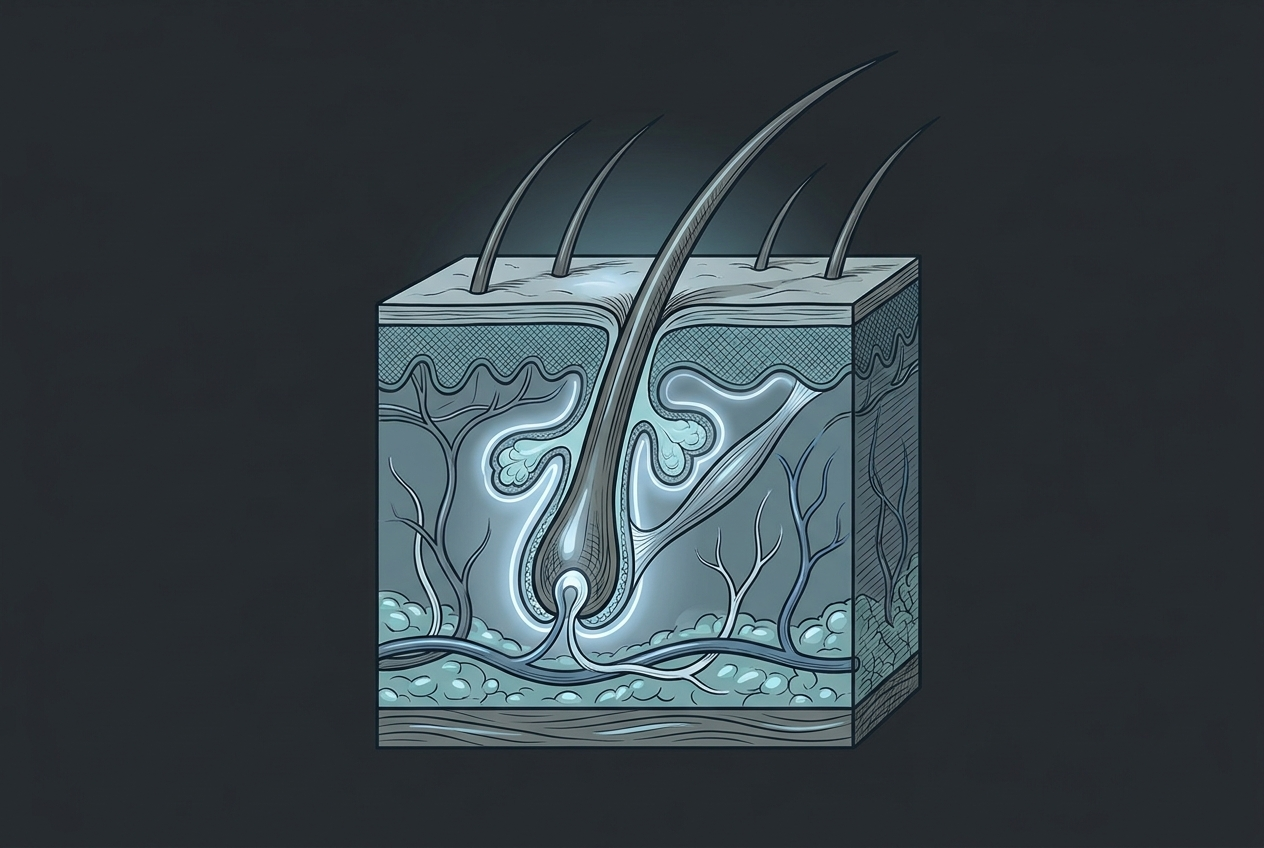
Hair Loss: A Comprehensive Overview
The full map — the growth cycle, what genetics decide, what they don’t, and how the four root causes overlap in practice.
Read →
The Scary Truth About Buying Peptides Online
Research-only vials, unverifiable purity, no batch testing. What to demand from anyone selling you a peptide — including us.
Read →
How Does Restore Actually Work?
One dropper, four pathways. A walk through what each active in the formula is doing from the moment it hits the scalp.
Read →
Behind The Engineering Of Maneup Labs
How a formula gets built: what made the shelf, what got cut for lack of evidence, and why the label reads the way it does.
Read →Exploring The Biological Pathways Of Hair Loss
Androgen, follicular, vascular, inflammatory — the four pathways in detail, and what each one responds to.
Read →Know the science? Now find your protocol.
Answer a few questions about your hair, your history, and your goals. Your starting protocol comes out the other side — the right one, not the default one.